
To stay competitive in modern business, showing up is no longer enough; professionals must commit to continuous improvement. For professionals in product development and project management, the Scrum framework offers a powerful way to deliver value, and the Scrum Alliance certification system provides a clear roadmap for personal and career advancement.
The need for Agile skills is in demand. According to a Global Knowledge report, 97% of IT professionals value certifications as worthwhile, with Scrum credentials frequently listed as the most desirable. Scrum Alliance data also indicates that certified individuals report greater job satisfaction and steadier career advancement, proving these credentials are a practical investment for any professional.
Understanding the Scrum Alliance Ecosystem
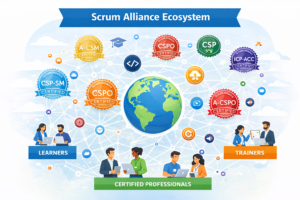
Founded in 2001, the Scrum Alliance is a global nonprofit organization that has helped over 1.5 million people master Agile methodologies. Choosing this path isn’t just about a certificate; it’s about joining a massive support system. Here is why it stands out:
- Professional Credibility: You earn prestigious credentials. These are “gold standard” badges that prove to employers you know your stuff.
- Exclusive Tools: Members get high-value resources, like a premium subscription to Comparative Agility (worth $299/year), which helps you benchmark how well your team is actually doing.
- Networking: You gain access to “Scrum Gatherings” and local user groups. This allows you to meet mentors and peers who can help you land your next big role.
- Expert Instruction: Every course is taught by a Certified Scrum Trainer (CST). These trainers are strictly vetted, ensuring you get practical, high-quality education rather than just theory.
Starting Points: Foundational Certifications
Your journey mostly begins with these fundamental certifications, perfect for understanding the core principles of Scrum, regardless of your specific role.
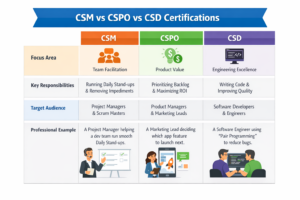
1. Certified ScrumMaster (CSM)
- Who it’s for: Individuals who want to help teams understand and use Scrum effectively. This is ideal for those who will facilitate Scrum events, coach the team, and remove obstacles.
- What you learn: Scrum roles, events, artifacts, and how to guide a team through the Scrum process. You’ll become the “servant-leader” of your Scrum team.
2. Certified Scrum Product Owner (CSPO)
- Who it’s for: Individuals responsible for guiding the product direction and maximizing the value of the work done by the Scrum Team. This is crucial for anyone managing a product backlog.
- What you learn: How to create a product vision, manage a backlog, prioritize features, and represent the customer’s needs to the development team
3. Certified Scrum Developer (CSD)
- Who it’s for: Technical professionals (programmers, testers, architects) who want to learn how to build software in an Agile way.
- What you learn: Agile engineering practices like Test-Driven Development (TDD), Pair Programming, and continuous integration, all within a Scrum framework.
The Mid-Level Ascend: Advanced Certifications
Once you have experience with a foundational certification, you can deepen your expertise and specialize.
1. Advanced Certified ScrumMaster (A-CSM)
- Who it’s for: Experienced ScrumMasters looking to grow their facilitation, coaching, and conflict resolution skills beyond the basics.
- What you learn: Advanced techniques for dealing with challenges, scaling Scrum, and transforming organizations.
- Why it matters: It shows you can handle more complex situations and teams.
2. Advanced Certified Scrum Product Owner (A-CSPO)
- Who it’s for: Experienced Product Owners who want to master advanced product strategy, stakeholder engagement, and value delivery.
- What you learn: Techniques for advanced product discovery, managing diverse stakeholder groups, and creating impactful product roadmaps.
- Why it matters: Demonstrates your ability to drive significant product success.
The Peak of Expertise: Professional and Coaching Certifications
These certifications are for those who want to become true leaders, coaches, or trainers in the Agile space, guiding others on their journey.
1. Certified Scrum Professional (CSP)
- CSP-SM (ScrumMaster): For A-CSMs who want to become expert facilitators and coaches, capable of transforming multiple teams or even departments.
- CSP-PO (Product Owner): For A-CSPOs who excel at product strategy, portfolio management, and leading complex product initiatives across an organization.
- CSP-D (Developer): For CSDs who have mastered advanced engineering practices and can mentor other developers.
- Why it matters: These show deep experience and the ability to apply Agile principles in highly complex environments.
2. Certified Agile Coach (CAC)
- Certified Team Coach (CTC): For experienced Agile practitioners who want to coach multiple Scrum Teams.
- Certified Enterprise Coach (CEC): For top-tier coaches who guide entire organizations through Agile transformations.
3. Certified Scrum Trainer (CST)
- Who it’s for: The highest level, enabling you to teach official Scrum Alliance certification courses.
The Continuous Journey: Beyond Certification
While holding CSPO certification (or any other Scrum Alliance badge) is a significant achievement, it’s just one step on your continuous learning path. Agile is about adaptability, and so is your career.
- Continuous Learning: Attend webinars, read books, and follow thought leaders. The Agile landscape is always changing.
- Community Involvement: Contribute to Agile discussions, share your experiences, and mentor others.
- Practice, Practice, Practice: Apply what you learn in your daily work. Scrum is an empirical process, meaning you learn by doing.
Conclusion: Invest in Your Agile Future
The Scrum Alliance certification system offers a clear, progressive path for anyone serious about a career in Agile. From understanding the basics as a Certified ScrumMaster or Product Owner to becoming an Enterprise Coach, each step builds on the last, equipping you with valuable skills and recognized credentials. By investing in this personal development journey, you’re not just earning a badge; you’re building a resilient, adaptable, and highly valuable professional profile ready for the challenges and opportunities of tomorrow. Which certification is your next target?